
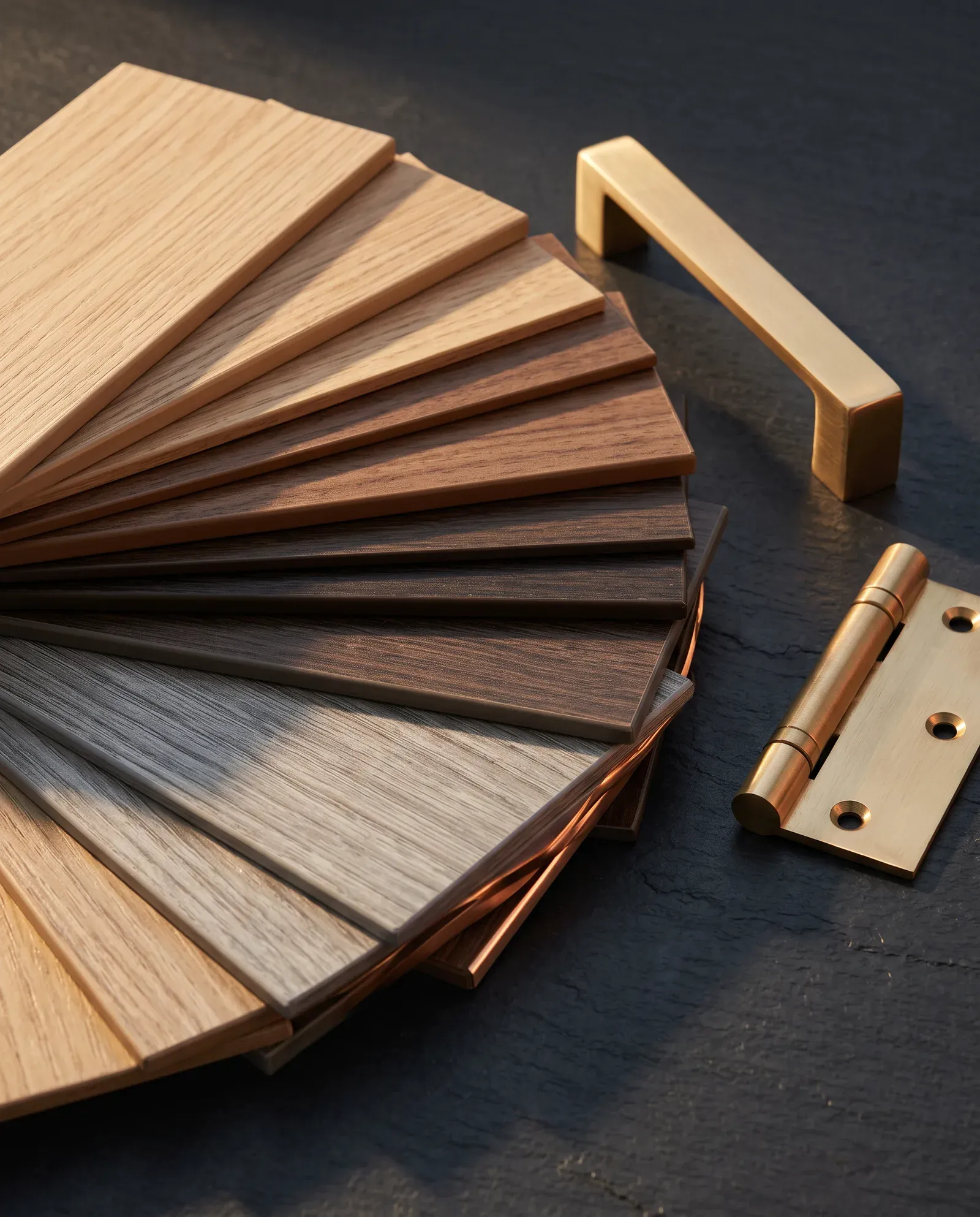
Short answer: in Sri Lanka’s humid climate, the edges, finish and hardware matter as much as the material. Melamine-faced board (often sold as MFC, melamine-faced chipboard) is stable and easy to clean, good for wardrobes and storage when every edge is sealed. HDHMR (High Density High Moisture Resistance board) is denser and more moisture-resistant, so it suits kitchens and humid areas. Plywood also handles moisture well. MDF gives the smoothest finish for painted doors in dry areas. For wet areas such as bathrooms and sink units, treated hardwood with an exterior-grade protective coating, such as teak or mahogany, lasts best. Solid wood also suits frames, legs, beds and statement pieces. Termites can attack any wood-based material, so check for them before built-ins go in and keep furniture off damp walls and floors.
Why climate matters
Humidity in Sri Lanka stays high for much of the year, especially through the monsoons. Wood and wood-based boards absorb moisture from the air and release it again. Poorly chosen or poorly finished materials swell, warp, peel or lose their screw grip. Choosing the right material for each place, and finishing it properly, is what makes built-in furniture last.
Termites (white ants) and wood borers
Damp is not the only threat. Termites (white ants) and wood borers can damage built-in furniture from the inside, often before you notice anything.
- Any wood-based board or timber can be attacked, especially where it sits against or near damp walls and floors.
- Teak heartwood is naturally resistant. Other timbers, and plywood, last longer when they are preservative-treated.
- Check for termite activity before built-ins go in, and have it treated first. Look for mud tubes on walls, timber that sounds hollow, and small piles of fine powder (a sign of borers).
- Seal backs, bases and edges, leave a gap between furniture and damp walls, and use plinths (raised bases) or legs rather than standing cupboards directly on the floor.
No wood or wood-based board is completely safe from termites. Treatment, sealing and keeping furniture dry reduce the risk; they don’t remove it.
Two terms used in this guide: treated timber or plywood has had a preservative treatment against termites, borers and decay. An exterior-grade protective coating is a sealer, varnish or paint system made for outdoor or wet conditions, applied to every face and edge to keep water out of the wood.
Melamine-faced board
What it is: a board with a decorative melamine surface fused on, often in wood-grain or plain colours. The core is usually particleboard (chipboard) or MDF; melamine-faced chipboard is often sold as MFC.
Strengths:
- stable: doesn’t twist or bow the way solid timber can,
- the surface resists moisture, stains and scratches, and is easy to wipe clean,
- consistent colour and grain across large wardrobe and cabinet fronts.
Weak points:
- raw edges and cut-outs absorb moisture, so every exposed edge needs edge banding,
- screw holes can loosen if hinges and drawer runners (the slides that drawers run on) are over-tightened or repeatedly removed.
Best for: wardrobes, storage walls, shoe cabinets, TV units and dry kitchen areas.
MDF (medium-density fibreboard)
What it is: a dense board made from fine wood fibres.
Strengths:
- very smooth and even, ideal for painted finishes, grooves and routed details,
- no grain or knots to show through paint.
Weak points:
- standard MDF swells if water gets in, and the swelling doesn’t go away,
- heavy for its size.
Best for: painted doors, panels and decorative details in dry rooms. Keep it away from sinks and wet areas.
HDHMR (High Density High Moisture Resistance board)
What it is: a high-density engineered board made to resist moisture, denser and harder than standard MDF or particleboard. It is often supplied with a decorative laminate or melamine face.
Strengths:
- resists moisture and humidity far better than standard MDF and particleboard,
- dense and strong, so it holds screws and hinges firmly,
- stable: stays flat for large doors and carcasses (the main box of a cupboard or wardrobe).
Weak points:
- heavier than plywood,
- edges and cut-outs still need sealing; moisture-resistant does not mean it can stay wet.
Best for: kitchen cabinets, pantry units and furniture on outside walls. For sink units and vanities, use it fully sealed and only where the cabinet stays dry; for anything that gets wet, treated teak or mahogany with an exterior-grade protective coating is the most durable.
Plywood
What it is: thin layers of wood glued with alternating grain directions.
Strengths:
- handles humidity and occasional water better than particleboard and standard MDF,
- strong, holds screws well, lighter than MDF and HDHMR.
Weak points:
- the surface usually needs a laminate, veneer or paint finish,
- quality varies widely; cheap plywood can delaminate.
Best for: kitchen carcasses and furniture that may meet occasional water.
HDHMR or plywood?
Both suit kitchens and humid rooms, so the choice comes down to the job. HDHMR is denser and flatter, with a consistent face that takes laminate well, which suits large, flat doors and carcasses. Plywood is lighter and sags less over long spans such as wide shelves, but quality varies, so ask for a moisture-resistant grade made with water-resistant glue.
Solid wood
What it is: timber cut directly from the tree.
Strengths:
- strong and long-lasting, with a natural look,
- can be sanded, repaired and refinished over its life,
- hardwoods such as teak and mahogany, when treated and given an exterior-grade protective coating, are the most durable choice for wet areas.
Weak points:
- expands and contracts with humidity, so wide panels can crack or warp if not designed for it,
- needs properly seasoned timber, suitable joints and a good finish,
- usually costs more than board for the same piece.
Best for: bathroom vanities and anything regularly wet (treated teak or mahogany with an exterior-grade protective coating), bed frames, table tops and legs, sofa and chair frames, and feature pieces.
Compared at a glance
| Material | Moisture resistance | Screw holding | Weight |
|---|---|---|---|
| Melamine-faced board (on particleboard/chipboard or MDF) | Surface resists moisture; raw edges and cut-outs absorb it | Screw holes can loosen if hardware is over-tightened or repeatedly removed | Depends on the core board |
| Standard MDF | Swells if water gets in, and the swelling doesn’t go away | Not as firm as HDHMR | Heavy for its size |
| HDHMR | Far better than standard MDF and particleboard; edges still need sealing | Holds screws and hinges firmly | Heavier than plywood |
| Plywood | Handles humidity and occasional water better than particleboard and standard MDF | Holds screws well | Lighter than MDF and HDHMR |
| Solid teak or mahogany | Most durable for wet areas when treated and coated; moves with humidity | Strong; needs suitable joints | Varies with the timber |
Prices vary with the grade, finish and hardware, so compare quotes for the finished piece rather than the price of a sheet of board.
Quick guide by room
| Where | Good choices | Pay attention to |
|---|---|---|
| Wardrobes and storage | Melamine-faced board | Edge banding, hinges, drawer runners |
| Kitchen carcasses | HDHMR, moisture-resistant plywood | Edge sealing, cut-outs |
| Sink unit | Treated teak or mahogany with an exterior-grade protective coating (most durable); fully sealed HDHMR only where the cabinet stays dry | Sealing around the sink and plumbing |
| Kitchen doors | HDHMR or plywood with laminate; painted MDF away from water | Edge finish, handle fixing |
| Bathroom vanities | Treated teak or mahogany with an exterior-grade protective coating (most durable); fully sealed HDHMR only where the cabinet stays dry | Full coating, raised off the floor |
| TV units and wall panels | Melamine-faced board, MDF | Ventilation and cable cut-outs |
| Beds and frames | Solid wood | Seasoned timber, joint design |
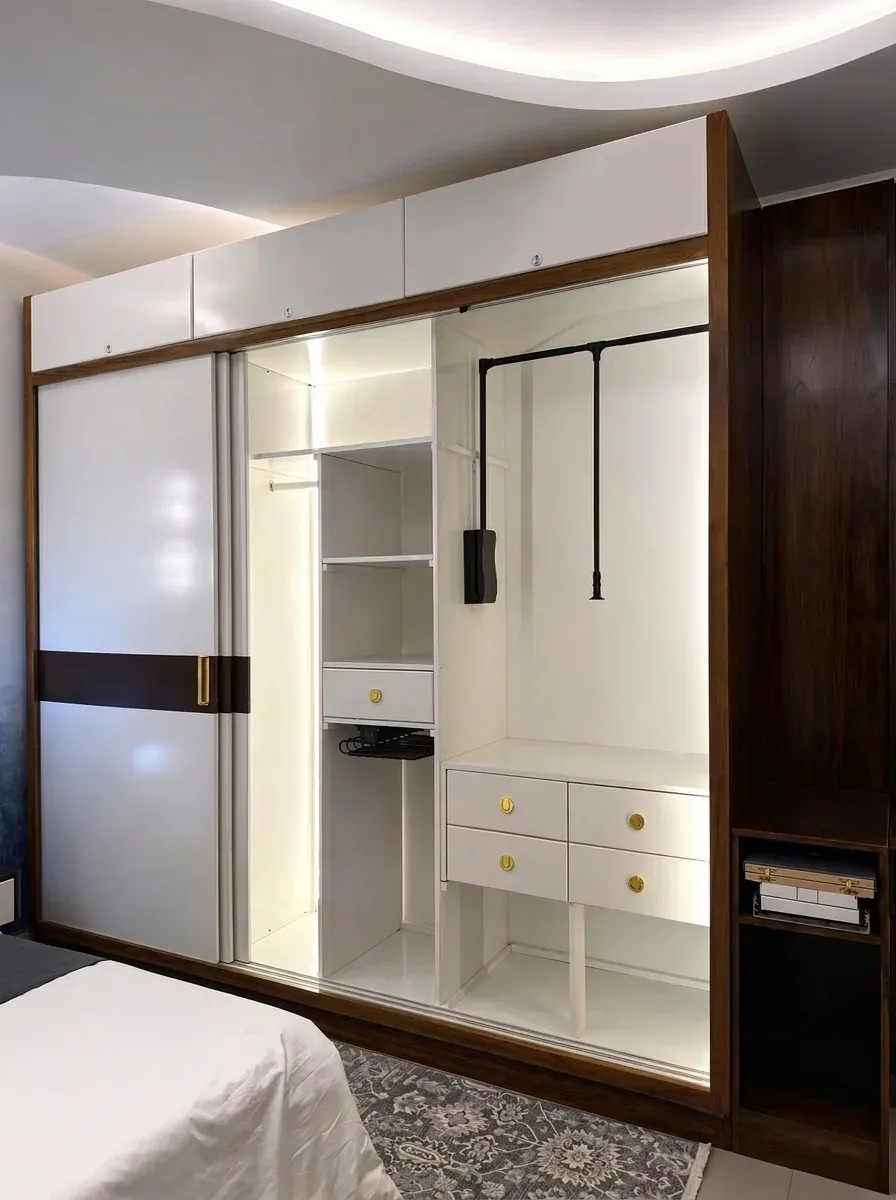
A built-in wardrobe SM Interiors made for The Heights apartment, Narahenpita.
Details that decide how long it lasts
Whichever material you choose:
- Seal every edge. Exposed edges are where moisture gets in.
- Coat wood that will get wet. Even teak and mahogany last far longer with preservative treatment and an exterior-grade protective coating.
- Deal with termites first. Have any termite activity treated before built-ins go in.
- Use good hardware. Hinges and runners carry the daily load; cheap ones fail first.
- Leave ventilation behind units on outside walls and around appliances.
- Keep furniture off wet floors. Use legs, plinths or sealed bases in kitchens and bathrooms.
- Ask what the warranty covers: structure, hardware (hinges and runners), finishes, and whether termite damage is included.
How we work at SM Interiors
SM Interiors is an interior design and furniture fabrication studio in Kelaniya, serving Colombo and suburbs, with around 90 residential and commercial projects completed since 2023. We choose materials room by room for how each space is used, and we make the furniture in-house to the approved drawings, including edge sealing and fitting the hardware. We work with melamine-faced board, MDF, plywood and HDHMR, and for areas that get wet we recommend treated hardwood with an exterior-grade protective coating, such as teak or mahogany. Our furniture carries a 5-year warranty on its structure against manufacturing defects (surface finishes and hardware, such as hinges and drawer runners, are not covered). The timber we use is treated, but we can’t guarantee furniture against termites, and termite damage isn’t covered by the warranty. Before built-ins go in, have the site checked, and treated if needed, by a pest-control company.
Related: How to choose an interior designer in Sri Lanka · 15 questions to ask before hiring an interior designer in Sri Lanka · Interior designer, carpenter or design-and-build in Sri Lanka?
Common questions
Is melamine board good for wardrobes in Sri Lanka?
Yes, when it is a good-quality melamine-faced board with properly applied edge banding on every exposed edge and good hinges and runners. The melamine surface resists moisture and stains; the weak points are unsealed edges and cut-outs.
What is HDHMR board?
HDHMR stands for High Density High Moisture Resistance board. It is a dense engineered board that resists moisture and holds screws better than standard MDF or particleboard, which makes it a strong choice for kitchen cabinets and other humid areas.
Which material is best for wet areas like bathrooms and sink units?
For anything that regularly gets wet, treated teak or mahogany with an exterior-grade protective coating is the most durable choice. 'Treated' means a preservative treatment against termites, borers and decay. Fully sealed HDHMR can be used for a sink unit or vanity only where the cabinet itself stays dry.
Do termites attack MDF, plywood or melamine board?
They can. Termites (white ants) feed on the cellulose in wood, so any wood-based board or timber can be attacked, especially near damp walls and floors. Preservative-treated plywood lasts longer. Check for and treat termite activity before built-ins go in, seal backs, bases and edges, and keep furniture away from damp walls and floors with a gap, a plinth or legs. No board is completely safe from termites.
Is solid wood always better than board?
Not always. Solid wood is strong and repairable but moves with humidity, so it needs the right design, seasoning and finish. Good boards are dimensionally stable, which is why most modern wardrobes and kitchens use them for large panels.
HDHMR or plywood for a kitchen in Sri Lanka?
Both handle a kitchen's humidity well. HDHMR is denser and flatter, with a consistent face that takes laminate well. Plywood is lighter and sags less over long spans such as wide shelves, but quality varies, so ask for a moisture-resistant grade made with water-resistant glue. For the sink unit, treated teak or mahogany with an exterior-grade protective coating is the most durable; use fully sealed HDHMR only where the cabinet stays dry. Edge sealing and hardware matter as much as the board itself.